August 1, 2024

TSX60 Series
Observations clés sur la rémunération des cadres du TSX60 - Une analyse approfondie de l'Environnement, du Social et de la Gouvernance (ESG) ainsi que de la Diversité, de l'Équité et de l'Inclusion (DEI)
Les mesures ESG sont courantes dans les régimes d'intéressement à court terme, avec 62 % des entreprises du TSX60 incorporant au moins une mesure ESG. Leur prévalence continue d'augmenter progressivement dans les régimes d'intéressement à long terme. La plupart des entreprises du TSX60 divulguent la parité hommes-femmes au sein de la haute direction et du conseil d'administration, et la divulgation concernant d'autres groupes sous-représentés devient de plus en plus courante. Téléchargez le rapport gratuit de Laulima sur l'ESG et le DEI des entreprises du TSX60 pour en savoir plus.
Laulima - Conclusions ESG et DEI du TSX60

Laulima - Conclusions ESG et DEI du TSX60

TSX60 Key Executive Compensation Observations
A Deeper Dive into Environmental, Social, and Governance (ESG) and Diversity, Equity, and Inclusion (DEI)
The 2023 ESG and DEI disclosures¹ by the TSX60 companies reveal several key observations across major sectors. Most notably, Laulima's findings suggest:
- ESG metrics are common in short-term incentive plans (STIP), with 62% of TSX60 companies incorporating at least one ESG metric (includes both quantitative and qualitative non-safety metrics).
- ESG metrics are not as common in long-term incentive plans (LTIP), but prevalence continues to increase among TSX60 companies on a gradual basis, with one company introducing an environmental metric (TC Energy) and one company introducing a diversity metric (Fortis) in their PSU plans in the past year.
- Most TSX60 companies disclose gender representation across the senior management and Board of Directors levels, with disclosure for other underrepresented groups becoming more common.
This article highlights key insights into the use of ESG metrics in short- and long-term incentive plans and disclosure on senior management and Board of Directors' diversity.
ESG Metrics in STIP
- ESG metrics are well incorporated in STIP, with 62% of companies incorporating at least one non-safety ESG metric in their STIP (note - this includes companies that disclose the use of ESG metrics even if a weighting is undisclosed).
- The Financials, Energy, and Materials sectors all have above-average usage of ESG metrics in STIP compared to the entire TSX60 index. In the Energy and Materials sectors, it is particularly common to see environmental metrics, given the nature of these industries. Outside of these three sectors, the prevalence of ESG metrics drops to 43% (from 62%).
¹ Data sample reflects 2022 and 2023 public disclosures as of July 10, 2024 and includes ESG performance metrics that are clearly defined in the STIP and LTIP. Individual ESG objectives are excluded. Safety metrics are also excluded.

Proxy Advisor Perspective
Glass Lewis is supportive of companies incorporating material environmental and/or social ("E&S") risks and opportunities in their long-term strategic planning. However, they believe that the inclusion of E&S metrics in compensation programs should be predicated on each company's unique circumstances, including their industry, size, risk profile, maturity, performance, financial condition, and any other relevant internal or external factors.
When introducing E&S criteria into executive incentive plans, Glass Lewis believes it is important to provide shareholders with sufficient disclosure to ensure understanding on how these criteria align with the company's strategy.
- Among the companies that use ESG metrics in their STIP, these metrics account for a median weighting of 15% (excluding 0s) across all TSX60 companies, 20% among Financials, 10% among Energy, and 15% among Materials.
- In the last year, six TSX60 companies across various sectors increased the weighting of ESG metrics or added new ESG metrics. Some notable examples are listed below:
Example 1
Cenovus Energy updated their scorecard to include a new sustainability performance index. This index replaced GHG emissions and doubled the weighting to 10% to better reflect the company's broader approach to sustainability and their ESG focus areas: climate & GHG emissions, water stewardship, biodiversity, Indigenous reconciliation, and inclusion & diversity.
Example 2
Dollarama will add new ESG metrics related to people and climate for fiscal 2025.
ESG Metrics in LTIP
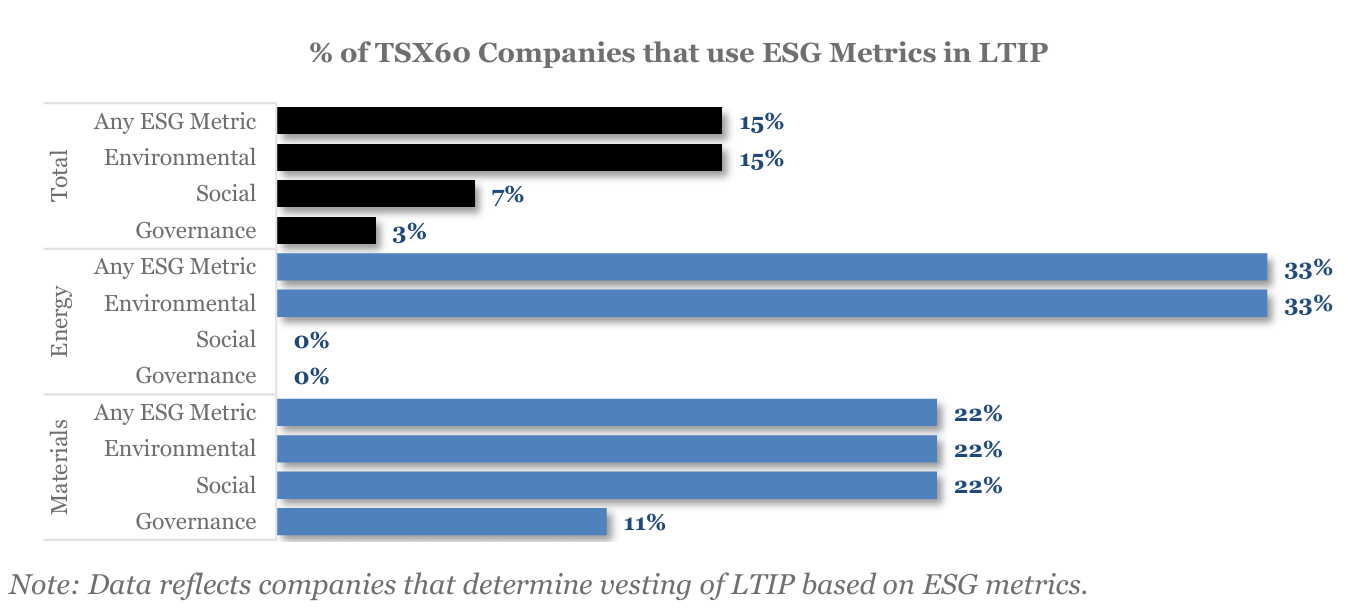
- Although only 15% of companies currently incorporate a non-safety ESG metric into their LTIP, this is an area of discussion and continued examination for many Compensation Committees and management teams.
- It is more common for Energy and Materials companies to include ESG metrics in their LTIP. In fact, outside of Energy and Materials, only four companies include ESG metrics in their LTIP.
- Among the companies that use ESG metrics in their LTIP, these metrics account for a median weighting of 10% (excluding 0s) across all TSX60 companies, 10% among Energy, and 20% among Materials (Financials sector companies do not include ESG metrics in their LTIP).
- In the last year, two companies introduced ESG metrics in their PSU plans:
Example 1
TC Energy introduced a methane reduction metric, weighted at 10%, to measure progress against decarbonization targets.
Example 2
Fortis included a DEI modifier (+/-5%) focused on the achievement of corporate-wide executive representation targets for gender and ethnicity in the PSUs that were awarded in 2023. As this award covers the period from January 1, 2023 through to the end of 2025, no DEI modifier was added for the 2024 PSU awards.
Senior Management and Board of Directors Diversity
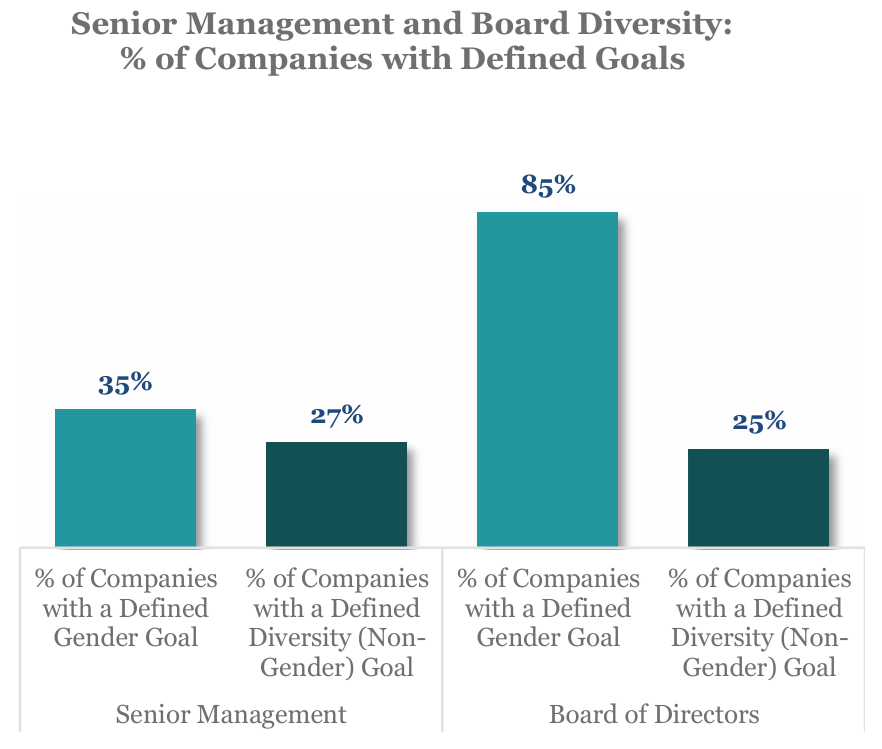
- Gender diversity targets at the Board level are very common among TSX60 companies (85% of companies have a defined gender goal for their Board), but are less common for senior management (35% of companies have a defined gender goal for their senior management team).
- 27% of TSX60 companies have adopted diversity targets beyond gender, including targets for racial, ethnic, and other underrepresented groups for their senior management team, while 25% of TSX60 companies have adopted these targets for their Board of Directors.
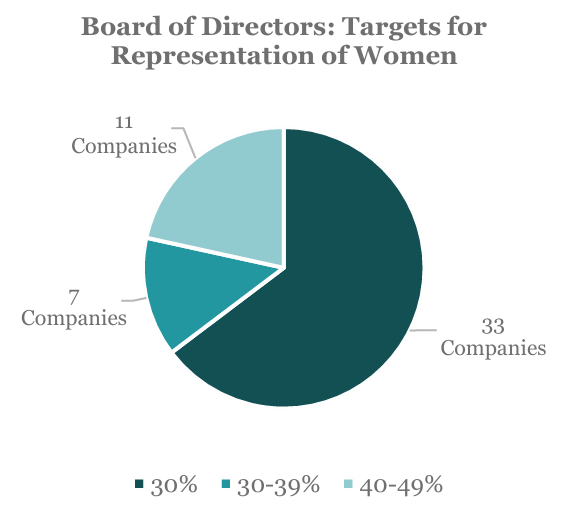
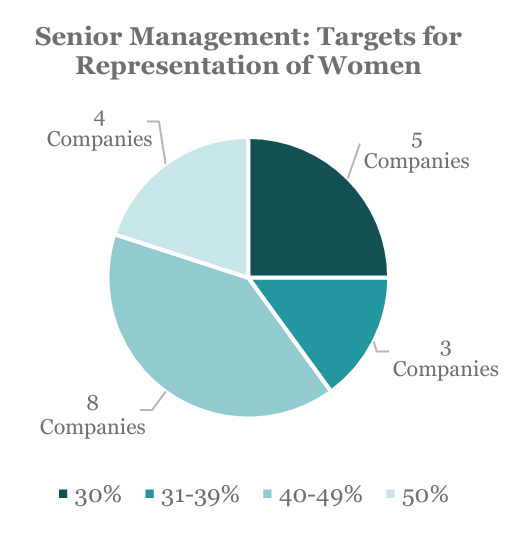
- Gender diversity targets at the Board level range from 30% to 45% women (majority is 30% women), and from 30% to 50% women at the senior management level (majority is 40% women).
- Out of the 9 TSX60 companies that disclosed a specific gender goal for their senior management team and reported their achievements for 2024, only one company has successfully met their goal.
- Out of the 51 TSX60 companies that disclosed a specific gender goal for their Board of Directors and reported their achievements for 2024, 48 companies have successfully met their goal.
- Despite some TSX60 companies not having formal diversity targets, many still disclose representation on their management teams and Board of Directors, signaling the increasing importance of this disclosure for investors:
- 68% disclose gender representation on their senior management team.
- 42% disclose other minority (non-gender) representation on their senior management team.
- 68% disclose other minority (non-gender) representation on their Board of Directors.
Proxy Advisor Perspectives
ISS Perspective (new for 2024)
For S&P/TSX Composite Index companies, ISS will generally vote "withhold" for the Chair of the Nominating Committee where women comprise less than 30% of the Board of Directors. ISS will also generally vote "against" or "withhold" for the Chair of the Nominating Committee where the Board has no apparent racially or ethnically diverse members and the company has not provided a formal, publicly disclosed written commitment to add at least one racially or ethnically diverse director at or prior to the next AGM.
ISS will evaluate on a case-by-case basis whether "against/withhold" recommendations are warranted for additional directors at companies that fail to meet the policy over two years or more.
Glass Lewis Perspective (updated in 2023 to a percentage-based approach)
For TSX-listed companies, Glass Lewis will generally recommend "against" the Chair of the Nominating Committee where the board is not at least 30% gender diverse, or the entire Nominating Committee of a board with no gender diverse directors.
Glass Lewis may refrain from recommending that shareholders vote against directors when boards have provided a sufficient rationale or plan to address the lack of diversity on the board, including a timeline of when the board intends to appoint additional gender diverse directors (generally by the next annual meeting or as soon as is reasonably practicable).
In the past year, we continued to witness an evolution in the ESG landscape among the TSX60. Companies continued to review how they measure, report, and integrate ESG metrics into their compensation plans. Looking ahead, companies will likely continue their discussions on if and how ESG should be incorporated in incentive plans.
While this will come with challenges and complexities, companies that choose not to align incentives with ESG priorities and/or step up their ESG disclosure risk falling behind in a rapidly evolving global landscape and the transition to a more sustainable future.
Having said that, companies must prioritize their own strategies over simply following market trends. With investors increasingly expecting objective measures and aggressive yet achievable targets, companies must focus on identifying, measuring, and effectively tracking their progress in ESG efforts to clearly demonstrate what executives are held accountable for.
Stay tuned for more TSX60 executive compensation insights in the coming weeks.
For more information or to sign up for our newsletters, contact us at info@laulimaconsulting.com.
Follow us on LinkedIn.
Lire plus d'articles
VOIR TOUT



.svg)


Dropdown