Executive Rewards

Managing Executive Pay in a Changing Economic Climate
With market volatility on the rise and global trade tensions resurfacing, companies are once again faced with familiar questions: ✅ How do we stay competitive in an unpredictable market? ✅ Are our incentive plans resilient enough to adapt? Laulima explores how companies can make thoughtful compensation decisions — balancing agility with accountability.
Download Laulima's article here

Download Laulima's article here

TOPIC: EXECUTIVE COMPENSATION
Managing Executive Pay in a Changing Economic Climate:
Are we Back to Pandemic-Era Thinking?
As market volatility resurfaces, and geopolitical uncertainty intensifies — from FX swings to trade tensions — Canadian Boards are once again navigating a familiar challenge: how to ensure executive compensation programs remain fair, effective, and aligned with shareholder and stakeholder expectations.
Recent shifts in international trade policy — including a temporary easing of some tariffs — may provide short-term relief for Canadian businesses with global supply chains. Nonetheless, tariff levels remain elevated worldwide, and the broader environment continues to strain both import and export activities, heightening recession concerns. These dynamics create ripple effects that influence operational costs, corporate strategy, and investment decisions which drive compensation program design.
Among several of the priorities that companies are facing today, two stand out as especially important from an executive compensation perspective:
- Competing for top talent in North America; and
- Managing short- and long-term incentive plans (“STIP” and “LTIP”).
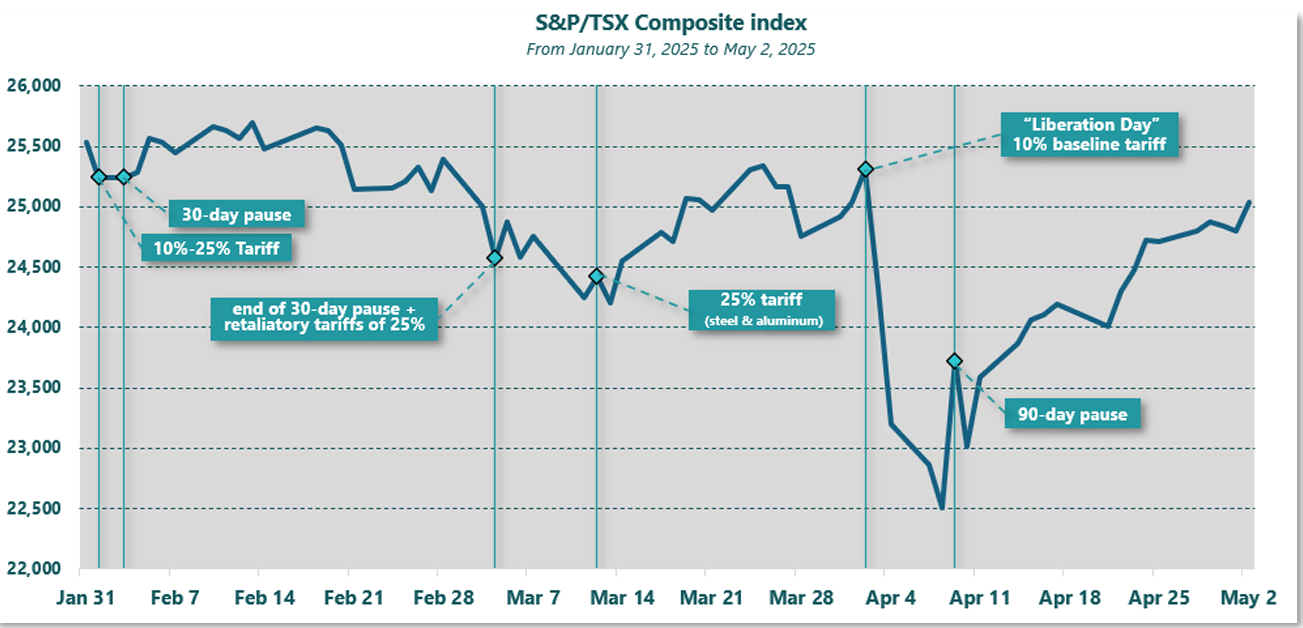
Recent actions by the U.S. administration have sparked sharp market fluctuations that are challenging investor confidence.
#1 – Is our approach to compensation competitive with both the Canadian and U.S. talent pools?
While recent swings in exchange rates and trade tensions may be cause for concern for organizations with cross-border talent pools, the demand for top-tier executive talent has not disappeared.
Key considerations:
- Many companies recruit key talent from the U.S. Fluctuating exchange rates have made this increasingly challenging by weakening Canadian compensation competitiveness and increasing the cost of hiring U.S.-based executives.
- Our recent FX spot poll shows that most organizations are not adjusting their approach to FX in pay benchmarking, with the majority continuing to rely on historical average exchange rates. However, a prolonged period of CAD weakness or sustained FX volatility could eventually lead to a shift in strategy.
- With a weaker CAD, some Canadian companies may put more focus on recruiting local talent; however, we expect many will continue to prioritize attracting the ‘right’ person for the role, regardless of domicile.
- Some Canadian organizations have shifted towards an integrated North American pay philosophy by treating Canada and the U.S. as a single talent market for the purposes of setting pay levels. In certain cases, companies have made targeted increases for their Canadian executives to be more aligned to the U.S. talent market.
Companies will continue to pay for top talent. The question is how to do so thoughtfully, without locking into unsustainable pay structures, or creating internal equity issues.
Some approaches may include:
- setting compensation levels at fixed exchange rates;
- offering one-time awards; and
- using relocation allowances that decrease over time; etc.
Market dynamics are still evolving, and making premature adjustments to various components of your executive compensation may lead to unintended consequences.
#2 – Are our incentive plans built to withstand this kind of uncertainty?
Most companies have already approved their 2025 STIP and LTIP design, including performance metrics and targets. However, the rapidly changing economic climate may raise concerns about whether to stay the course or consider adjustments to pre-established incentive plans.
If incentive targets are already set and LTIP grants have been made:
- Continue to monitor performance against approved metrics and targets and avoid knee-jerk reactions. Given ongoing uncertainty, it is too early to determine whether recalibrations are warranted. As seen during the COVID-19 pandemic, premature adjustments risk significant shareholder pushback.
- Identify any impacted metrics, quantify where possible the degree to which performance has been affected, and flag them in advance for discussion and for a more detailed review later in the performance cycle, once there is more clarity on the likely outcomes.
- Ensure proper guiding principles are in place to support the responsible use of discretion. Adjustments to incentive plans should maintain sufficient alignment with shareholder experience and broader stakeholder expectations.
- If incentive plan adjustments are needed, ensure that a strong rationale is developed and documented now. Transparency and timing are key to withstanding potential scrutiny.
- While proxy advisors like ISS and Glass Lewis accept the use of discretion, when warranted, companies must explain the “why” clearly and demonstrate alignment with performance and shareholder outcomes.
- What’s more, evolving trade relations could drive M&A activity and cause shifts in business priorities — potentially impacting the relevance or achievability of previously established incentive metrics and targets.
If incentive targets have not been set and LTIP grants have not yet been made:
- Maintain clear communication with stakeholders about the evolving environment. Set performance targets that are defensible and that allow for the potential use of discretion.
- In addition to ensuring executive pay is aligned with shareholder interests and business priorities, when determining incentive payouts, companies should consider employee perceptions. Perceived imbalances — such as executives earning a higher proportion of their target payouts than the broader workforce — can undermine morale, trust, and long-term engagement.
- Avoid unintended windfalls by carefully calibrating the size of equity awards and properly explaining your valuation approach in light of recent share price declines.
Boards and compensation committees face a difficult task: responding thoughtfully to economic uncertainty without compromising the integrity of their incentive plans or governance practices.
Don’t overreact, but don’t ignore what’s happening either. Approach decisions with clarity and care — because ‘how’ you decide is just as important as ‘what’ you decide.
Looking Ahead
In our view, companies should resist the pressure to act hastily unless a decision is imminent (e.g., an upcoming grant or bonus payout). Instead, focus on laying the foundation for transparent, well-reasoned decisions — rooted in business fundamentals, employee fairness, and long-term stakeholder alignment.
For practical guidance on building trust through compensation messaging, see Laulima’s point of view on Effective Total Rewards Communication Can Build Trust in Tough Times.
For more information or to discuss how we can support your organization in navigating human capital decisions during uncertain times, please contact us at info@laulimaconsulting.com.
Read more articles
SEE ALL


.svg)


Dropdown