November 18, 2024

Use of Special LTI Awards - Strategic or Problematic?
Long-Term Incentives (LTI) serve as a critical component of annual compensation across all sectors. In order to ensure that compensation supports critical business needs and strategy, companies sometimes provide additional one-time LTI awards to address exceptional circumstances, such as major acquisitions, leadership transitions, retention or new executive hires. Download Laulima's report for more details.
Download Laulima's article here

Download Laulima's article here

Use of Special LTI Awards
Strategic or Problematic?
Long-Term Incentives (LTI) serve as a critical component of annual compensation across all sectors. In order to ensure that compensation supports critical business needs and strategy, companies sometimes provide additional one-time LTI awards to address exceptional circumstances, such as major acquisitions, leadership transitions, retention or new executive hires. This article explores recent examples, the rationale for such awards, and considerations for effectively using special LTI awards.
Drivers and Key Vehicles for Special LTI Awards
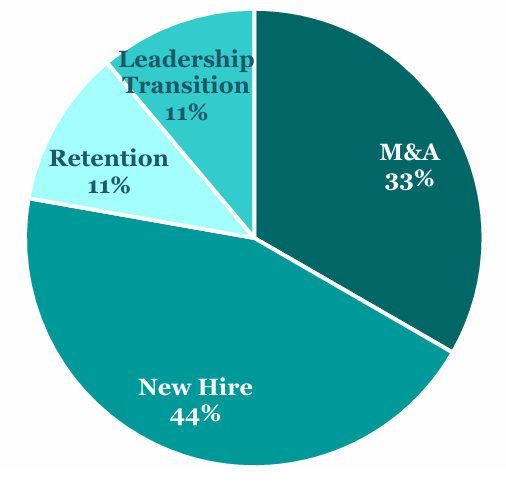
Out of the TSX60, eight (8) companies granted a special LTI award within the latest fiscal year.
Special LTI awards are often granted for the following reasons:
- Mergers and acquisitions (M&A), since leadership continuity and successful integration is critical.
- New hires, to entice new recruits and/or compensate for forfeited compensation at a previous employer.
- Retention, where there is a clearly identifiable and significant flight-risk for mission critical talent.
- Leadership transitions, to support succession, reward promotion and/or limit disruption in the event key individual(s) exit the organization.
Vehicles
Performance Share Units (PSU), Restricted Share Units (RSU) and Performance-based Stock Options (PSO) are the primary instruments used for special awards:
- PSUs are used for M&A integration and are therefore contingent on meeting certain pro forma earnings targets or share price targets. They are also used as new hire awards and therefore may be contingent on the same metrics used for regular awards.
- RSUs are used to enhance retention (because of leadership transition and for new hires) and simply time-vest at the end of 3 years or more.
- PSOs are less common. In one recent instance, OpenText awarded a special PSO which vests contingent upon the achievement of certain share price hurdles in order to promote integration following M&A.
Special awards of PSUs and RSUs sometimes have longer vesting periods, as is the case with Restaurant Brands (5 years) relative to conventional awards which most commonly vest over 3 years.
Examples of Special LTI Awards
Based on the most recent compensation disclosures of TSX60 companies, the following notable special LTI awards were granted in the last fiscal year.
CPKC
Vehicle: PSU
Following the acquisition of Kansas City Southern, CPKC granted special Synergy PSU awards with a term of 3.5 years to senior leaders (excluding the CEO). The award is contingent upon delivering synergies and meeting defined EBITDA targets. The structure shows how companies can align special LTI awards with measurable financial goals, ensuring that leadership is directly accountable for achieving critical business objectives.
Say-on-Pay Vote Result in 2024: 94.05%
Intact
Vehicle: PSU
As part of the hiring package, the CEO, U.K. & Ireland was awarded a one-time special PSU award in the amount of GBP 1.22 million to secure his service beyond 2026 and provide “meaningful alignment to [company] share price and performance leverage to align his compensation with the strategic plan to bring the U.K. & Ireland business to outperformance”.
50% of PSUs vest January 1, 2026 (paid in March) and 50% vest January 1, 2027 (paid in March) subject to U.K. & Ireland combined ratio performance.
Say-on-Pay Vote Result in 2024: 96.36%
Restaurant Brands International (RBI)
Vehicle: PSU
The CEO received a one-time award of PSUs valued at approximately $24 million in connection with his appointment. Awards cliff vest after 5 years based on achievement of predetermined share price performance targets (50% at $81.32, 100% at $97.87, or 200% at $122.23).
Say-on-Pay Vote Result in 2024: 90.36%
Rogers Communications
Vehicle: PSU & Stock Options
The President, Rogers Sports & Media received a one-time $1 million integration award contingent upon achievement of 1- and 2-year milestones to recognize the strategic importance of decisions within the media portfolio following the Shaw Communications deal close.
The President, Wireless also received $1.65 million in PSUs (50%) and stock options (50%) in recognition of the Shaw transaction. Other executives received certain transaction-related incentives (including cash bonuses and PSOs) in 2022.
No Say-on-Pay vote held in 2024
Enbridge
Vehicle: RSU
Enbridge awarded $2 million in RSUs to its EVP of Corporate Strategy and President of Power, to “assist in assuring continuity and execution of Enbridge’s business plan through the transition of the President & CEO role”.
RSUs cliff vest after 3 years and are share settled. This special grant followed similar RSU retention awards made to three other executives in the prior year which cliff vest after 2 years.
Say-on-Pay Vote Result: 89.19% (2024); 90.75% (2023)
Loblaw Companies
Vehicle: RSU
The CEO was granted a one-time award of RSUs with 3-year cliff vesting as part of a “make whole” compensation arrangement to offset certain compensation forfeited upon resignation from a former employer.
Say-on-Pay Vote Result in 2024: 93.52%
Suncor Energy
Vehicle: RSU
Suncor provided one-time RSU awards totaling $23 million and $1.4 million to the CEO and EVP Downstream, respectively, to “make whole” for deferred compensation forfeited at previous employers.
Say-on-Pay Vote Result in 2024: 87.18%
OpenText
Vehicle: PSO (CEO); Stock Options (Other NEOs)
OpenText granted PSOs in fiscal year 2023 to the CEO “in recognition of the size, importance and need to achieve the stated benefits and synergies associated with the [Micro Focus] transaction”.
PSOs vest based on share price appreciation of 20% (threshold), 40% (target) and 60% (maximum) above the exercise price. Any shares acquired must be held until the earlier of 5 years after grant date or termination of employment.
Other NEOs received regular stock options with 4-year vesting as an incentive to “successfully integrate Micro Focus and execute on the combined company’s operational goals over the next two to four years”.
For 2023, OpenText failed its Say-on-Pay vote due in part to the timing and amount of CEO PSOs ($10.6 million in stock options versus $2.5 million in 2022 and 2024).
In 2024, ISS acknowledged that OpenText had engaged shareholders and made some positive changes to its compensation practices (including the intention to discontinue use of one-time grants on a go-forward basis). However, both ISS and Glass Lewis still recommended an against vote based on pay-for-performance tests (which capture multi-year historical pay).
Say-on-Pay Vote Result: 25.1% (2024); 29.5% (2023)
Proxy Advisors’ Guidelines¹ on Special LTI Awards
Both Glass Lewis and ISS are critical of special LTI awards, stressing the need for clear justification and alignment with shareholder interests.
Glass Lewis
- Generally opposes one-time or special LTI awards unless there is a strong strategic rationale tied to extraordinary events.
- Requires a compelling explanation as to why existing incentive programs were insufficient and how the additional awards will contribute to long-term goals.
- Highlights that special awards should be structured in a way that aligns executive performance with shareholder interests and should also be contingent upon future service and performance-based conditions whenever possible.
ISS
- Recommends that special LTI awards be granted sparingly and in response to significant non-recurring events.
- Emphasizes a preference for performance-based awards and expects clear disclosure on the rationale and how the grants tie into the overall compensation strategy.
- Reviews whether the awards are truly performance-linked, minimize dilution and are aligned with shareholder interests.
- Cautions against retention-focused grants that do not tie directly to measurable performance objectives, as this could undermine the company’s regular incentive programs.
Conclusion
While special LTI awards can be valuable tools for fostering retention and driving performance during periods of change, companies should approach them with caution and recognize that they are not a substitute for well-designed, comprehensive regular LTI programs.
When special LTI awards are deemed truly necessary, companies must:
- Identify and develop a clear and compelling justification for special LTI awards and be prepared to disclose the rationale for granting such awards.
- Structure and deliver any performance-based awards with rigorous performance conditions that are stress-tested to ensure a clear link to shareholder value creation and clearly disclose the mechanics.
- For retention-focused awards, ensure transparency in disclosure pertaining to the purpose and timing and underlying rationale for the absence of performance metrics.
- Test potential realizable pay outcomes in addition to outstanding and expected grants of annual awards.
- Be prepared to engage with shareholders to further explain the award's purpose and structure.
To stay updated with the latest insights and trends in executive compensation and rewards, visit our website and subscribe to our newsletter at www.laulimaconsulting.com/subscribe.
For more information, send us an email at info@laulimaconsulting.com.
¹ ISS Canada Proxy Voting Guidelines for TSX-Listed Companies Benchmarking Policy Recommendations; Glass Lewis 2024 Canada Benchmark Policy Guidelines.
Lire plus d'articles
VOIR TOUT




.svg)


Dropdown