November 6, 2025

M&A Series
Navigating M&A - Retention & Transaction Bonuses
Mergers and acquisitions (M&A) are high-stakes events that create both opportunity and uncertainty. For companies navigating these transitions, one of the greatest risks is losing the people who hold critical knowledge and relationships that enable business continuity. M&A-related bonuses are proven tools to keep key talent engaged, motivated, and aligned with shareholders when it matters most.
Download Laulima's article here

Download Laulima's article here

TOPIC: M&A SERIES
Navigating M&A Retention & Transaction Bonuses: The Glue in High-Stakes Deals
Mergers and acquisitions (M&A) are high-stakes events that create both opportunity and uncertainty. For companies navigating these transitions, one of the greatest risks is losing the people who hold critical knowledge and relationships that enable business continuity. M&A-related bonuses are proven tools to keep key talent engaged, motivated, and aligned with shareholders when it matters most.
To determine if M&A-related bonuses are necessary, the first step is to identify key roles related to the transaction where a departure would materially create risks for business continuity. After defining this group, the question becomes whether pro-active action is required to support the retention and engagement of these employees and, if so, in what form.
To answer this, companies should assess the current state of compensation programs and entitlements under employment and/or change-of-control (CoC) agreements. This is often part of the due diligence process (see key workstreams in Aligning People, Pay & Performance of Laulima’s Navigating M&A series).
Many companies already have compensation programs that provide some degree of “stickiness” / retention and alignment; offering additional compensation without this context can create overlap or unnecessarily increase compensation costs.
Key questions to consider include:
- What elements of current compensation already incentivize employees to stay? (e.g. bonuses, long-term incentives, etc.)
- When are the existing incentives scheduled to vest and/or pay out?
- What are the current contractual protections or triggers, such as CoC provisions or severance arrangements that offer security or payout upon a transaction?
- Are there key individuals or groups whose current arrangements may not be sufficient to ensure commitment or alignment through the critical period?
What are the types of incentives used in M&A? The type of M&A transaction shapes incentive design. In a divestiture, incentives may target a narrow set of roles (limited to the small group of individuals involved, as it is often complex and sensitive in nature). In a sale, needs can vary depending on whether the buyer is financial (typically seeking to retain management) or strategic (where consolidation may occur).
Context also matters. The strength of existing incentives can lessen or heighten the need for additional awards. Companies should review whether a M&A-related bonus can be used to create or strengthen alignment with shareholder interests.
Timing needs for retention and alignment vary across employee groups. Continued employment for some employees only needs to be secured through the close of a transaction (i.e. require short-term retention and alignment), while others are essential to post-close integration activities and must be incentivized for a longer period. Distinguishing between these groups ensures that M&A-related bonuses are both focused and effective, and optimize the return on investment of additional compensation.
Below outlines common types of M&A-related bonuses – companies can choose to use one or a mix of the incentive types, depending on the situation and needs of the company:
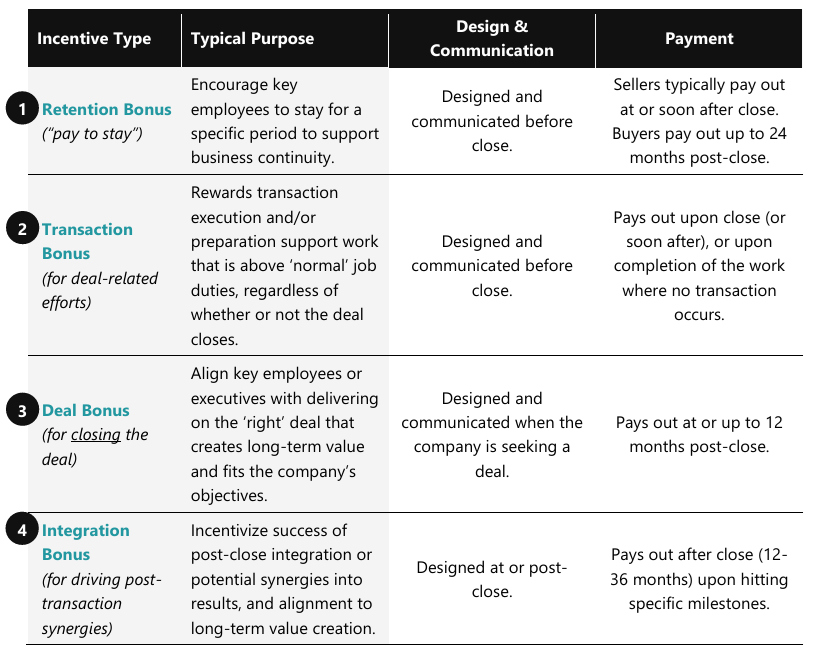
1) When is a retention bonus used?
M&A retention bonuses are “pay to stay” arrangements designed to ensure stability of key talent. They are layered on top of the existing compensation structure, providing additional incentive for employees to stay.
Retention bonuses can be considered for key talent among both the buyer and the seller, and sometimes both parties to the transaction work collaboratively to identify roles and/or individuals who are critical to the transaction and determine how best to retain them. Welldesigned programs share common features:
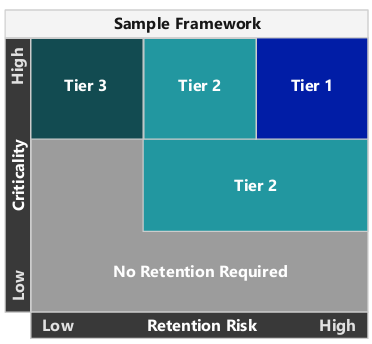
• Focused on employees who could be likely to leave and whose departure would materially impact the business – one approach is to consider the dimensions of “Criticality” and “Retention Risk” to identify employees that are priority for retention (see Sample Framework below):
• Typically structured in cash or equity.
• Duration is often for up to 24 months.
• May include cliff vesting (one payment at the end) or staggered payouts over time.
• Meaningful award size that varies by role criticality, risk or impact, usually presented as a percentage of salary or fixed amount.
• Designed to provide stability during uncertainty and discourage voluntary exits.
Retention bonuses typically vest solely on continued service, with no performance conditions attached. For sellers, the priority is to retain key employees through to closing to preserve deal value and continuity. For buyers, the focus shifts to retaining those same individuals post-close to ensure a smooth transition and realization of synergies.
2) How are transaction bonuses different?
Transaction bonuses are provided to critical employees for taking on transaction execution and/or preparation support work beyond their normal responsibilities. Typically, these bonuses are:
• Targeted to those critical to deal success and who have provided exceptional efforts during one or more of the key phases of the transaction.
• Participation is usually narrower, focusing on executives and key deal contributors (can be on the seller-side or the buyer-side).
• Typically delivered in cash rather than equity.
• Pays out upon close or soon after, or upon completion of the work where no transaction occurs.
Transaction bonuses can be paid for by the seller (for delivering on the seller’s exit) or the buyer (for the additional work required in delivering on the purchase) as these bonuses reward employees for extraordinary effort in supporting the transaction, regardless of whether the deal closes.
3) When should companies consider a deal bonus instead of a transaction bonus?
Deal bonuses are designed to reward individuals for finding and closing the ‘right’ deal that creates long-term value and fits the company’s strategic objectives. For the seller, the ‘right’ deal can mean maximizing the sale price (a closed sale at a good valuation) and for the buyer, it may mean evaluating a variety of targets and securing a deal that delivers strong strategic fit or synergies. Typically, these bonuses are:
• Targeted to individuals who are critical to the success of closing a transaction and are required to make a substantial contribution.
• Can be delivered in cash to provide immediate recognition or equity to maximize shareholder alignment.
• Payout timing at close or up to 12 months post-close.
Deal bonuses help ensure alignment when current incentive structures do not adequately motivate or reward the specific actions and decisions critical to achieving the intended transaction outcomes.
4) What are integration bonuses?
Integration bonuses are designed to motivate and reward employees for successfully executing post-close integration activities that are essential to realizing the deal value. Typically, these bonuses are:
• Focused on employees who play key roles in post-transaction integration, synergy realization, or system/process alignment.
• Broader in participation than transaction bonuses, may include functional leaders and integration project teams.
• Tied to clearly defined milestones (e.g., system migration, cost synergy targets, operational stability).
• Usually delivered in equity over 12–36 months post-close.
Integration bonuses are funded by the buyer, as the benefits of a successful integration and value capture accrue post-close. These awards promote the importance of revenue and/or cost synergies, ensure business continuity and drive execution during the transition period.
How do I decide which program to use?
Selecting the right mix of M&A-related bonuses depends on the nature of the transaction, the risks at each stage, and the roles that are most critical to success. While all can be powerful tools for managing uncertainty and rewarding exceptional effort, they serve different purposes.
Ultimately, the right approach balances timing, purpose, and participation – ensuring that incentives are not only cost-effective but also reinforce the behaviours and outcomes that matter most. Knowing who the critical talent is and identifying if there are potential gaps in retention and alignment is a critical HR & Compensation Workstream within the M&A process.
Stay tuned for our next Navigating M&A article.
For more information on how we can help, contact us at info@laulimaconsulting.com.
Lire plus d'articles
VOIR TOUT


.svg)


Dropdown