TSX60 Series

TSX60 Research - Executive Pay Insights (June 2026)
An overview of 2025 executive compensation practices among TSX60 companies, highlighting Say-on-Pay results, CEO and CFO pay levels, incentive outcomes, long-term incentive design, and emerging governance trends.
TSX60 Research - Executive Pay Insights (June 2026)

TSX60 Research - Executive Pay Insights (June 2026)

TOPIC: EXECUTIVE COMPENSATION
TSX60 Research
Executive Pay Insights – Strong Support, Stable Design and Continued Pay Increase
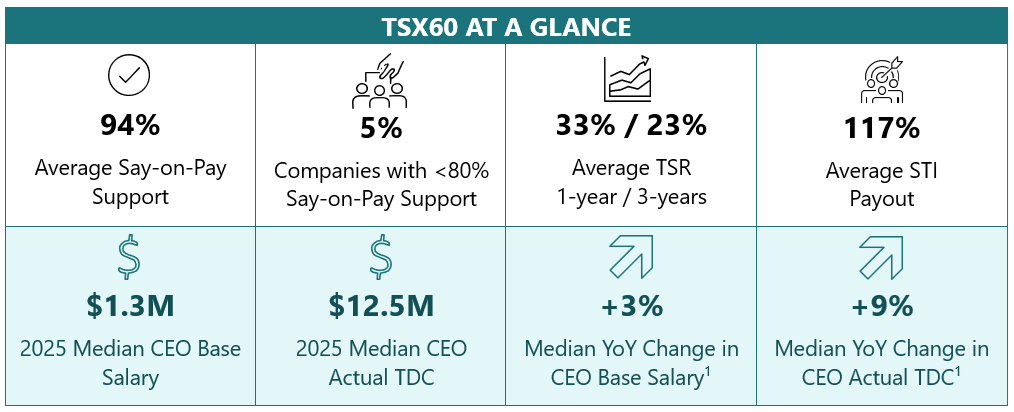
The 2025 TSX60 compensation season was characterized by strong shareholder support, stable compensation design, and above target incentive outcomes. Say-on-Pay support remained exceptionally strong. Short-term incentive payouts exceeded target again and long-term incentive structures saw limited changes. Pay levels increased notably for both CEOs and CFOs, reflecting continued efforts to maintain competitive compensation while preserving alignment between pay outcomes, company performance, and shareholder experience.
Despite continued economic and geopolitical uncertainty, many TSX60 companies demonstrated resilience in 2025 and delivered strong business performance and excellent shareholder returns.
Against this backdrop, human resources and compensation committees continued to balance talent attraction and retention needs with pay-for-performance discipline. The findings from this year’s review suggest that TSX60 issuers have made another round of meaningful increases to executive pay while applying largely the same compensation approach, continuing our stable and evolving theme from last year.
[1] For same CEO incumbents between 2024 and 2025.
Strong Say-on-Pay Support in 2026
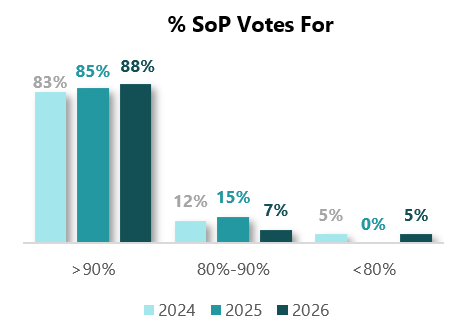
Say-on-Pay(SoP) support remained exceptionally strong across the TSX60, with an average shareholdersupport of 94% in 2026, broadly consistent with prior years. All but two companies received support of at least 87%, while the proportion of issuers with support above 90% rose from 85% in 2025 to 88% in 2026.[2]
[2] Say-on-pay voting results as of June 8, 2026.
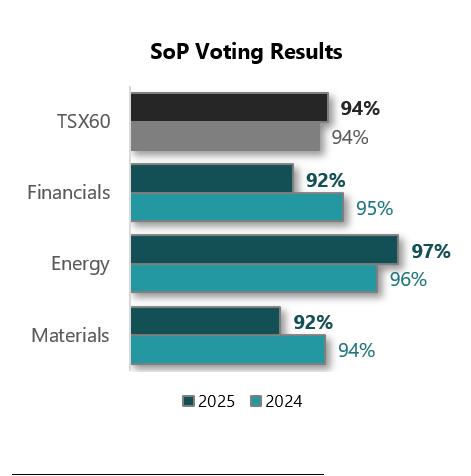
The continued strength of SoP results suggests that investors generally view executive compensation programs as appropriately aligned with company performance, governance practices, and shareholder expectations. Across theTSX60, the Energy sector showed the highest support levels, consistent with 2024.
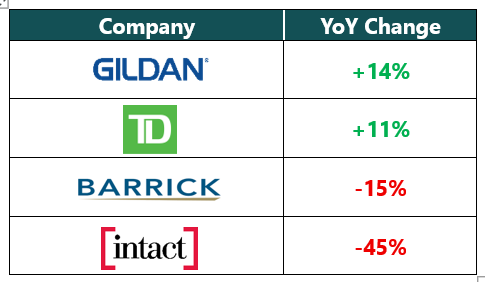
A small number of issuers experienced notable year-over-year changes, driven by company-specific governance, compensation and performance reasons.
Executive Pay Levels Continued to Increase
Among all TSX60 constituents, median base salaries for CEO and CFO increased by 3%. While target total direct compensation (TDC) rose meaningfully by 16% for CEOs and 20% for CFOs. Actual TDC increase was lower at9% for CEOs and 5% for CFOs.
Among the same incumbent CEOs and CFOs, 53% of CEOs and 73% of CFOs experienced base salary increases exceeding 3%. On the other hand, 28% of CEOs and 11%of CFOs saw no salary increase from 2024 to 2025.
While base salary increases are relatively moderate, target and actual TDC increased more significantly, for both CEOs and CFOs.
[2] Say-on-pay voting results as of June 8, 2026
The increase in target compensation suggests that many issuers continued to adjust executive pay levels to maintain market competitiveness.
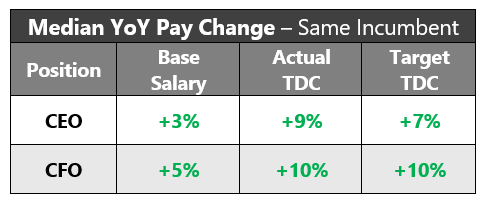
Actual compensation increases outpacing target compensation increases reflects above-target STI payouts during 2025. These increases occurred alongside generally positive business performance and strong shareholder support.
Pay Mix Remained Largely Stable
TSX60 pay mix remained broadly consistent with 2024, when we saw a noticeable increase in LTI.
While pay levels continued to increase, compensation design remained largely stable across theTSX60. Executive pay continues to be heavily weighted toward “at-risk” pay, delivered through STI and LTI.
Target and actual compensation increased notably for the 2nd year in a row for both CEOs and CFOs, while pay mix remained broadly consistent year-over-year.
STI Continued to Pay Out Above Target
STI outcomes remained above target across the TSX60 despite continued economic uncertainty, with the average corporate multiplier increasing from 112% in 2024 to 117% in 2025.

The Energy sector continuedto report the highest STI outcomes, with an average multiplier of 157%,followed by the Financials sector at 113%, as a result of notably higher payouts at a few individual issuers rather than broad sector performance. Materials was slightly below prior-year levels at 110%.
PSUs Continued to Dominate LTI Mix
LTI vehicle mix remained largely unchanged in 2025. Performance share units (PSUs)continued to be the most prevalent vehicle, used by 86% of TSX60 companies, underscoring the continued emphasis on performance-conditioned equity, followed by restricted share units (RSUs) at 59% and stock options at 57%.

PSUs also represented the largest component of theaverage LTI mix, accounting for 56% of target LTI value, compared to 25% forRSUs and 19% for stock options.
The use of two LTI vehicles continued to be the most common approach, rather than relying on a single vehicle or use a combinationof all three vehicles. These findings suggest that TSX60 issuers continue to complement the emphasis on performance-based equity with other LTI vehicles to provide balance and flexibility within program design.

Closing Thoughts
Notwithstanding the economic uncertainty, 2025 results reflect a compensation environment that saw another year of significant pay increases. However, shareholder support remained strong.
Looking ahead, the focus will be on whether and how companies respond to evolving expectations from shareholder advocates and proxy advisors (including the Canadian Coalition for Good Governance, Institutional Shareholder Services and Glass Lewis) and how Boards calibrate and communicate executive pay changes amidst changing environments. Clear disclosure, disciplined target setting, and a strong connection between pay and sustainable
Read more articles
SEE ALL





.svg)


Dropdown