July 20, 2026

TSX60 Series
TSX60 Research - Share Ownership Guidelines
Our latest TSX60 research examines executive share ownership guideline practices, emerging governance trends, and how leading Canadian companies are responding to evolving investor expectations.
Download the article here

Download the article here

TOPIC: SHARE OWNERSHIP GUIDELINES
TSX60 Research
Share Ownership Guidelines – Navigating the Evolving Guidance
Share ownership guidelines among TSX60 issuers remain largely unchanged year-over-year in spite of evolving guidance from Canadian Coalition for Good Governance. With the exception of updates from a few issuers, share ownership multiples, timelines for achievement and denomination as a multiple of base salary all remain largely unchanged.
Share ownership guidelines (SOGs) remain a standard feature of TSX60 executive compensation programs, designed to align executive and shareholder interests over the long-term. While the Canadian Coalition for Good Governance (CCGG) continues to emphasize the importance of meaningful executive share ownership to align management with shareholder interests, market practices remain largely unchanged. Most issuers continue to use salary-based multiples, many permit some form of unvested equity awards to count toward ownership requirements, and relatively few have adopted more prescriptive approaches such as total direct compensation-based guidelines or exclusive reliance on common shares towards achievement.
This article examines the key trends in how TSX60 companies structure and enforce their SOG programs in more detail, based on 2025 data (from 2026 proxy disclosures).
Governance and Proxy Advisor Developments
CCGG released its recommendations on effective SOGs in 2023, which at the time represented a significant shift in guidance. These guidelines, along with the proxy voting guidelines published by ISS and Glass Lewis, are summarized in more detail in our Rethinking Executive Share Ownership article (link to article).
Major shifts in the guidelines are intended to promote greater economic interests, express SOGs as a multiple of total direct compensation (TDC), limit the inclusion of unvested LTI towards achievement and provide clarity on the valuation of shares towards compliance. Changes to the Globe and Mail's Board Games scoring also reinforced the TDC denomination, and while proxy advisors remain less prescriptive, Glass Lewis explicitly discourages the inclusion of unearned PSUs towards compliance.
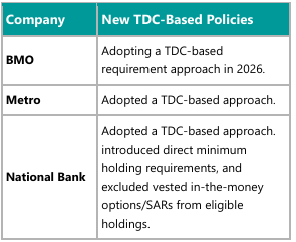
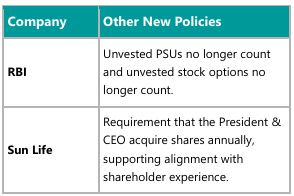
However, there have been few shifts in SOG policies among TSX60 issuers in latest disclosures, with the exception of the following:
New TDC-Based Policies
Other New Policies
TSX60 Market Practice
Ownership Multiples
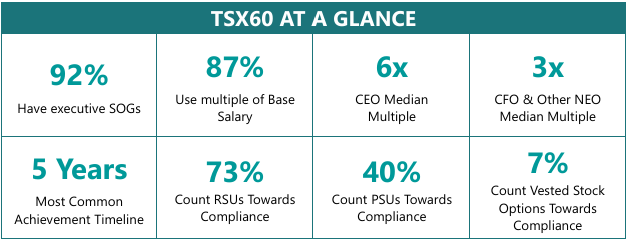
Multiple of base salary still remains the most common basis for SOGs, used by 87% of TSX60 companies that have SOGs in place. Only BMO, Metro, and National Bank have adopted TDC multiples for all executives.
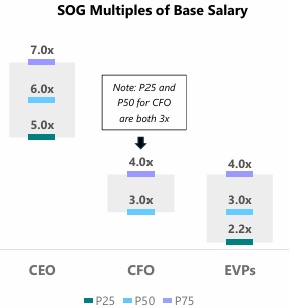
Median SOG multiples (as a multiple of base salary) held steady year-over-year at 6x for CEOs and 3x for CFO and other NEOs.
SOG Multiples of Base Salary
Timeline to Achievement
The majority of companies (76%) allow five years to reach achievement for all executives. The second most common is a three-year timeline, used by 11% of companies.
Determining Value of Securities
Out of the 29 companies that disclosed how they value securities for SOG purposes:
- 55% based on the greater of acquisition cost (i.e., value at grant) or market value
- 31% based on market value only
- 10% based on cost only
- 3% use a fixed number of shares
Post-Retirement Holdings
The prevalence of post-retirement holding requirements remained consistent with last year. Among TSX60 companies with SOGs, 53% also require CEOs to maintain equity holdings post-retirement (66% impose a one-year holding period and 34% require two years).
For other NEOs, 27% of companies have post-retirement holding requirements, most commonly for one year.
LTIP Vehicles Counting Towards Requirement
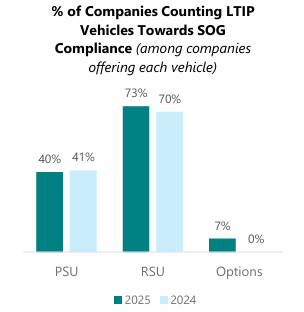
Where offered, all companies count DSUs towards SOG compliance. RSUs also commonly count towards compliance (73%).
Among companies that count PSUs (40%), 25% count only partial holdings (i.e., 50% to 80% of the value of unvested PSUs count toward the ownership requirement).
Only three companies (7%) count stock options (vested only).
As noted above, National Bank introduced direct minimum shareholding requirements and RBI excluded unvested PSUs and stock options from eligible holdings. By contrast, Suncor expanded eligible holdings by permitting unvested RSUs to count toward ownership requirements, provided that at least 25% of the guideline is satisfied through common shares and DSUs.
Minimum Common Share Requirement
Most companies do not impose a minimum common share ownership requirement.
Among the TSX60, only 14 companies count common shares and DSUs (if used). Additionally, six companies set explicit thresholds, requiring 25% to 50% of the SOG be met in common shares and/or DSUs.
Enforcement and Compliance Mechanisms
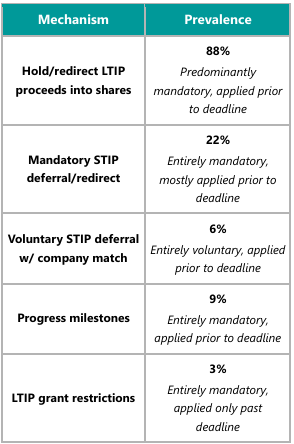
More than half of TSX60 companies (53%) have policies to promote or enforce SOG compliance. These mechanisms vary based on whether compliance is mandatory or voluntary, and whether they apply prior to the compliance deadline or only once the deadline has passed without compliance.
Most mechanisms are mandatory and proactive to keep executives on track (rather than waiting for a missed deadline), as the expectation is that executives meet their SOGs by the deadline.
Out of the companies that have enforcement and compliance mechanisms:
Looking Ahead
Most Canadian issuers appear to be treating CCGG's updated SOG guidance as an indicator of evolving investor expectations rather than a direct voting trigger. We nevertheless expect a gradual shift toward measuring SOGs as a multiple of TDC (or, at a minimum, enhanced disclosure of holdings relative to TDC), alongside a more conservative treatment of unvested equity, including the exclusion of PSUs and limiting the extent to which RSUs count toward ownership requirements.
Before implementing these changes, companies should assess the impact to ensure they are not unduly punitive unless a gap already exists relative to market practice. This evolution reflects the significant growth in LTIP award values, which has made guidelines based solely on base salary appear increasingly modest. TDC is emerging as a more meaningful ownership benchmark, complemented by post-vesting holding requirements that emphasize genuine long-term economic ownership.
Read our TSX60 Research – Executive Pay Insights article here.
Stay tuned for more TSX60 executive compensation insights in the coming weeks.
For more information or to sign up for our newsletters, contact us at: info@laulimaconsulting.com
Follow us on LinkedIn.
Read more articles
SEE ALL



.svg)


Dropdown